


How long do you need to study French in France before you notice a real difference?
There is no single answer. A beginner studying for two weeks, a B1 student staying for two months and an advanced learner preparing for an exam have completely different goals. What matters most is your starting level, the intensity of your course, how much French you use outside class and what you mean by “improve”. Even a short immersion stay can build confidence, but moving through an entire CEFR level normally requires much more time and practice.
How long do most international students study French in France?
| Length of study | Typical student/profile |
|---|---|
| 2–4 weeks | Short language study holiday, university break, summer study |
| 4–6 weeks | Students who want more substantial immersion and language progress. 5 weeks is the most common duration for language students in France. |
| 1 week | Recreational language holiday or add-on to a trip |
| 7–11 weeks | Students prioritising significant language development |
| 12+ weeks | Long-term study, academic/professional goals |
| 6–12 months | Long-term immersion, major CEFR progression or study pathway |
Can I improve my French in two weeks?
Yes, but set the right expectation.
Two weeks of intensive study will not normally transform a beginner into a fluent speaker. What it can do is make French feel more immediate and usable.
You may become faster at understanding common questions, more comfortable ordering food or asking for information, less hesitant about speaking and more aware of the gaps in your French. For students who have studied French at home but rarely use it in real situations, this can be an important breakthrough.
A short stay can also help restart French that has become rusty.
What about four weeks?
A month gives you more time to establish a rhythm.
The first few days of immersion can be mentally tiring because your brain is constantly processing another language. After a while, many learners find everyday exchanges become less intimidating and they stop translating every sentence word by word.
Four weeks also gives teachers more time to identify recurring weaknesses and gives you more opportunities to apply what you learn outside class.
You may not complete a full CEFR level in a month, particularly at intermediate and advanced levels, but you can make meaningful progress within your current level.
How long does it take to move up a CEFR level?
French schools commonly use the CEFR scale: A1, A2, B1, B2, C1 and C2.
Progress through those levels is not perfectly linear. Moving from beginner French to basic everyday communication is different from developing the vocabulary, accuracy and nuance expected at B2 or C1.
Your rate of progress depends on several factors:
- your starting level
- the number of classroom hours each week
- your attendance and participation
- how much French you use outside school
- previous experience learning languages
- the languages you already speak
- independent study and revision
- your individual learning pace
This is why promises such as “become fluent in four weeks” should be treated cautiously.
Does immersion make a difference?
Immersion can make your classroom hours work harder because learning continues after the lesson ends.
Imagine learning how to ask for recommendations in class and then using the same language in a bakery that afternoon. The next day you hear the expression again at a market. Later that week you use it without planning the sentence first.
That repeated cycle of learning, hearing and using French is difficult to reproduce when you study only a few hours per week at home.
How can I make the most progress during my stay?
Use French before you feel completely ready.
Speak to shopkeepers. Ask questions. Read menus and signs. Listen to French around you. Participate in school activities. If you stay with a French host, make conversation rather than disappearing into your room.
Do not measure progress only by grammar exercises. Notice whether you understand more, respond faster, hesitate less and can handle situations that felt difficult when you arrived.
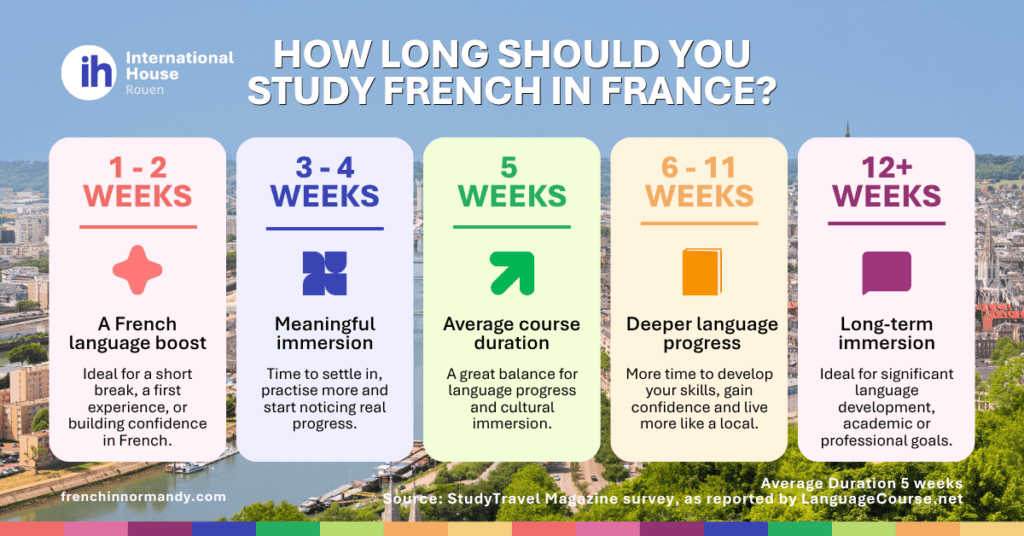
So, how long should I stay?
If you have only one or two weeks, come with focused goals and make every day count.
If you can stay for a month or more, you have more time to establish an immersion routine and consolidate what you learn.
If your goal is to move significantly through a CEFR level, prepare for a longer period of structured study and regular practice.
At French in Normandy, students can study in Rouen for different lengths of time depending on their level, availability and objectives. Before choosing the duration of your French language course, think about the result you want to take home with you, not simply the number of weeks you can put on a calendar.
